
Newsletter Subscribe
Enter your email address below and subscribe to our newsletter

Enter your email address below and subscribe to our newsletter

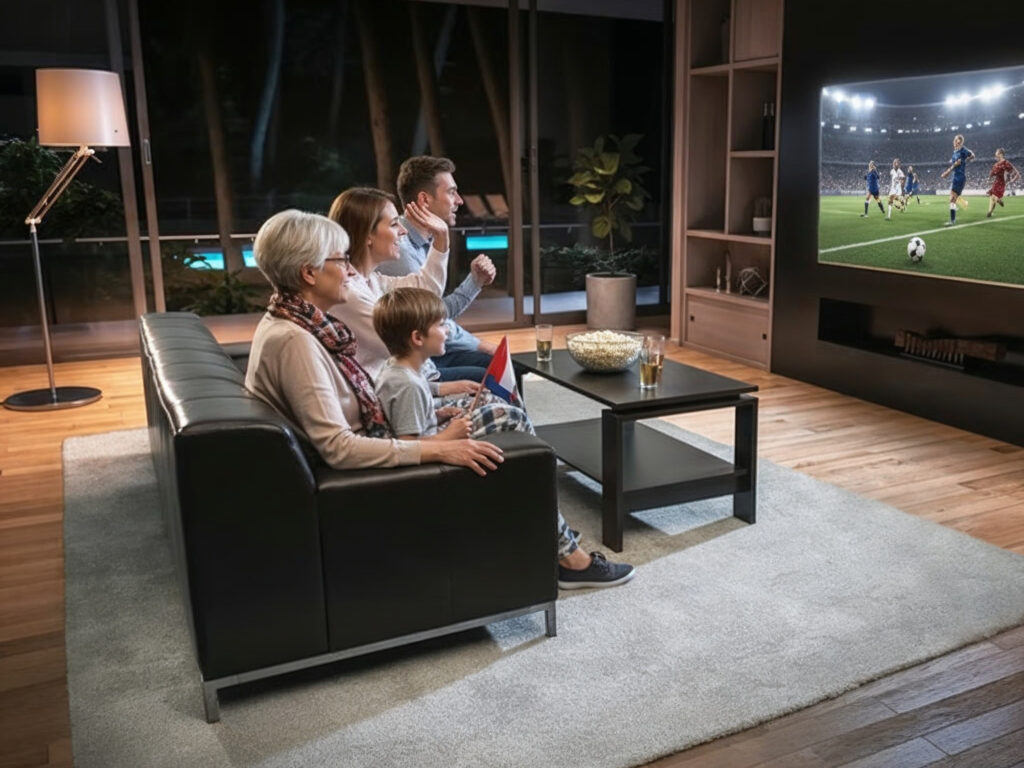
On any evening in the living room, what plays on which device—and who controls playback—shapes attention and conversation.
In November 2025, the head of sport at the BBC, the United Kingdom’s public broadcaster, said, “We measure success by how much we can engage people; the number we prioritize most is viewing time,” and cast the expansion of women’s sports coverage not as a moral imperative but as a move made because it sparks relationships with and reactions from audiences.
That raises the question of which viewing experiences count as “value” when viewing time in women’s sports is tallied.
UNESCO reports a 49% dropout rate from sport among adolescent girls (Source: UNESCO, 2024). This refers to discontinuing play and indicates a premise of fragile contact.
Audiences overlooked by relying solely on play as contact can be reached through the design of the viewing side—household and everyday watching habits.
As complements to wins, losses, and records, consider the following set.
They include quantities such as viewing time, simultaneous-viewing coefficient, and viewers per household, and qualities such as how long conversation persists after events.
Here, “co-viewing” refers to multiple people watching the same screen at the same time.
Quality works as an interpretive cue that fills in uncountable elements like post-event discussion and repeated routines.

UNESCO’s international framework upholds equal participation opportunities, and national school sports policies specify how to make this principle concrete.
A design that leans only on play as women’s sports’ point of contact is brittle, and the institutional foundation permeates household and community viewing habits.
In households, if routines form around watching women’s leagues or national-team games with the same family members or friends, “how much time” and “with how many people” can be counted.
In schools, if women’s sports are built into timetables and assemblies, they can be captured as a set—on-campus viewing time, number of viewers, and broadcast frequency.
Meanwhile, in communities, headcount, event frequency, and family-unit participation at watch parties or screenings become indicators of embedment, and repeated conversation—while not fully quantifiable—serves as a cue to track change.
Time metrics capture “how long people stayed,” and peak metrics capture “when the maximum gathered.”
The former asks whose time is being summed; the latter asks whose moment of focus is being observed.
In a 2024 report by U.S. measurement firm Nielsen, major sports events show examples where the simultaneous-viewing coefficient is around 2.0.
The simultaneous-viewing coefficient indicates how many people on average are watching a single screen.
Broadcasters and metric vendors have mostly optimized for large men’s events, but logic that treats mixed generations and co-viewing as quantities also applies to women’s sports.
ACR (automatic content recognition) directly reads the content shown on TV or device screens.
Combined with household attributes, viewing logs can estimate the number of people present and the generational mix.
It does not show who decided playback, but presence itself remains as numbers in viewing logs.
In sports evaluation practice, time and peak lenses are deeply rooted.
Within that premise, if broadcasters and metric vendors carry over indicators tuned on large men’s events to women’s sports without adjustment, even “which time slots and viewing styles count as proper growth” tends to get fixed by default.
Time models often assume solo viewing, thinning out co-viewing as a shared setting.
Peaks lean into instantaneous maxima and tend to miss people who were present without control, so, for instance, the experiences of children and older women are easily muted.
To capture the value of women’s sports, the crux is designing a system that pairs individual dwell time with co-viewing as a shared setting.
When focus concentrates on particular matches or players, gestures of support and ways of looking become formalized, and repeated patterns turn everyday routines into near-ritual.
For example, weekend games of a given women’s league can become a family routine.
Such repetition and sustained talk are hard to count but form the backdrop for reading contact density.
In the United States, ad spend for women’s sports is reported at 244 million dollars (Source: EDO, 2024).
Sponsors increasingly treat not just raw viewer counts but family-unit and local-event-unit contact as objects of evaluation in ad-effectiveness contexts.
Institutions support opportunities to play but do not set viewing indicators.
Hence, how “viewing and co-viewing” are built into broadcast slots and in-school distribution becomes the next design task.
If peak viewing alone is set as the standard, women’s sports are prone to the margins.
In contrast, if broadcasters and schools adopt, in parallel, the way time is shared (co-viewing) and the length of stay (viewing time) as complementary axes, women’s leagues in family-friendly slots and sports tied to schools and communities can move toward the standard.
The standard picture of viewing itself can be updated incrementally.
Depending on whose viewing experience is chosen as the baseline, how women’s sports are “measured” from here can still change.


